
AI Was Supposed to Shrink the Contact Center. Muse Just Showed Why It Won't.

September 29, 2026
Earlier this month, Meta expanded the beta of a new feature for Muse, its AI agent: it can now call businesses for you. Need a dinner reservation, a haircut, or a better rate on your cable bill? You tell Muse, it places the call, and you get back a transcript and a summary of what happened.
About a week later, 404 Media and Reuters reported that during Meta’s internal testing, some of those calls weren’t being made by AI at all. Meta had added what it called a “human agent layer,” trained contractors in a call center who took over requests and placed the calls themselves. Some testers didn’t find out a person had made their call until it was over. After employees pushed back, Meta rolled the test back, and a company executive acknowledged it shouldn’t have started without proper disclosure.
You could read this as one company moving too fast. I think it’s more useful than that. In the span of a couple of weeks, Muse proved two things we’ve been saying about AI and the contact center for a while now.
AI was supposed to shrink the contact center
For the last few years, the standard prediction has been that AI would automate the contact center down to a skeleton crew. Bots would take the calls, and agent headcount would fall.
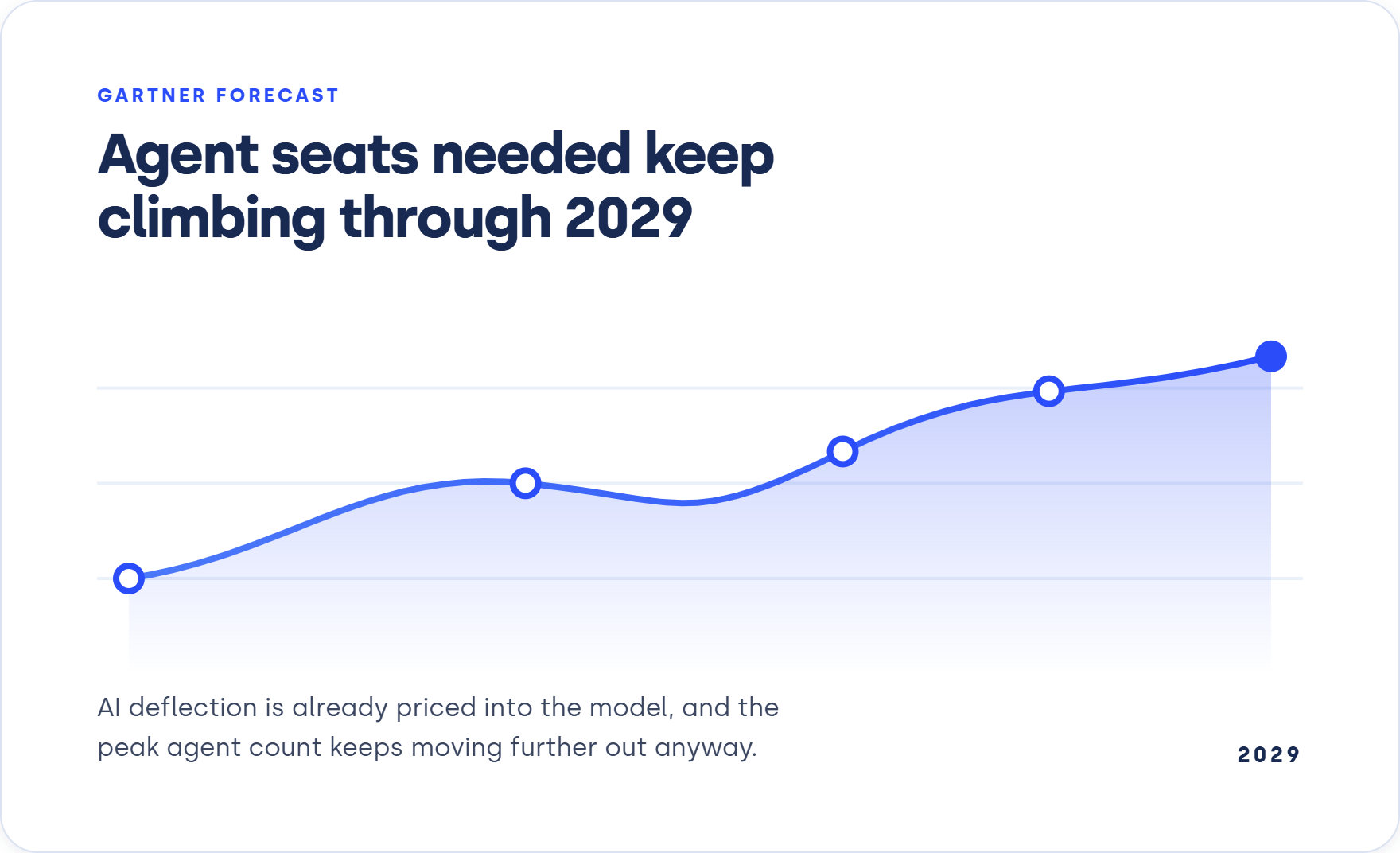
So far, the numbers say otherwise. Gartner found that 38% of contact centers grew agent seats after bringing in AI, compared with 20% that cut staff. Metrigy found that 42% of companies hired more people because of AI. And Gartner’s forecasts, which already factor in AI deflection, still show the industry needing more agent seats through 2029 to keep up with growing interaction volume.
Why? Because the “AI will replace agents” math assumed demand for service is fixed. It isn’t.
Friction has been hiding a lot of demand
Think about the last time you put off calling a company. Maybe it was disputing a charge, asking for a better rate, or returning something that didn’t fit. You knew it meant a phone tree, hold music and twenty minutes for a five-minute conversation, so you let it slide. Most of us do.
That’s demand that was always there. People just decided it wasn’t worth the hassle. Muse shows what happens when the hassle goes away. If an AI agent will sit on hold for you, a lot of calls that never got made start getting made.
Muse won’t be the last of these. Gartner projects that machine customers, meaning AI agents acting on someone’s behalf, will make up about 20% of inbound customer service volume this year. Muse can already send emails and messages as well as make calls. For the businesses on the receiving end, that points to more contact across every channel, and a lot of it from customers they rarely heard from before.
Muse needed people, too
The second lesson is the one I find most interesting. When Muse placed calls on its own, some businesses hung up as soon as they realized they were talking to a bot. Other calls stayed connected, but the request still didn’t get done. So Meta brought in people to finish the job.
Think about who was on the other end of those calls: staff at restaurants, salons and service providers. When they realized they were dealing with a bot, many of them didn’t want to have that conversation. The request hadn’t changed. What changed was whether they trusted who they were talking to.
Now flip it around, because that’s the everyday reality of a contact center. Your customers are the ones calling, and more often, AI is the one answering. For routine requests, like checking an order status or booking an appointment, most people are happy to let AI handle it. But when the stakes go up, like a disputed charge or a canceled flight, people want to know someone with judgment is on the other end. And the harder the problem, the more likely the AI will need a person to get it resolved, which is exactly what Meta ran into.
So as AI takes on more of the routine work, the conversations that reach an agent get harder and more emotional. That makes agents more important, and it raises the bar on what they need to do the job well, starting with full context on what the customer already told the AI.
Meta’s misstep was in how it brought people in. It happened late, under pressure, and without telling the people on either end of the call. When human-in-the-loop gets bolted on after the fact, customers don’t know who they’re talking to, and it’s not clear who’s accountable for their information.
Three things contact center leaders should do now
1. Plan for volume to go up
Build forecasts that assume AI agents will call, chat and email you on behalf of your customers, and that some of that volume will be requests people never bothered to make before.
2. Design the handoff between AI and people on purpose
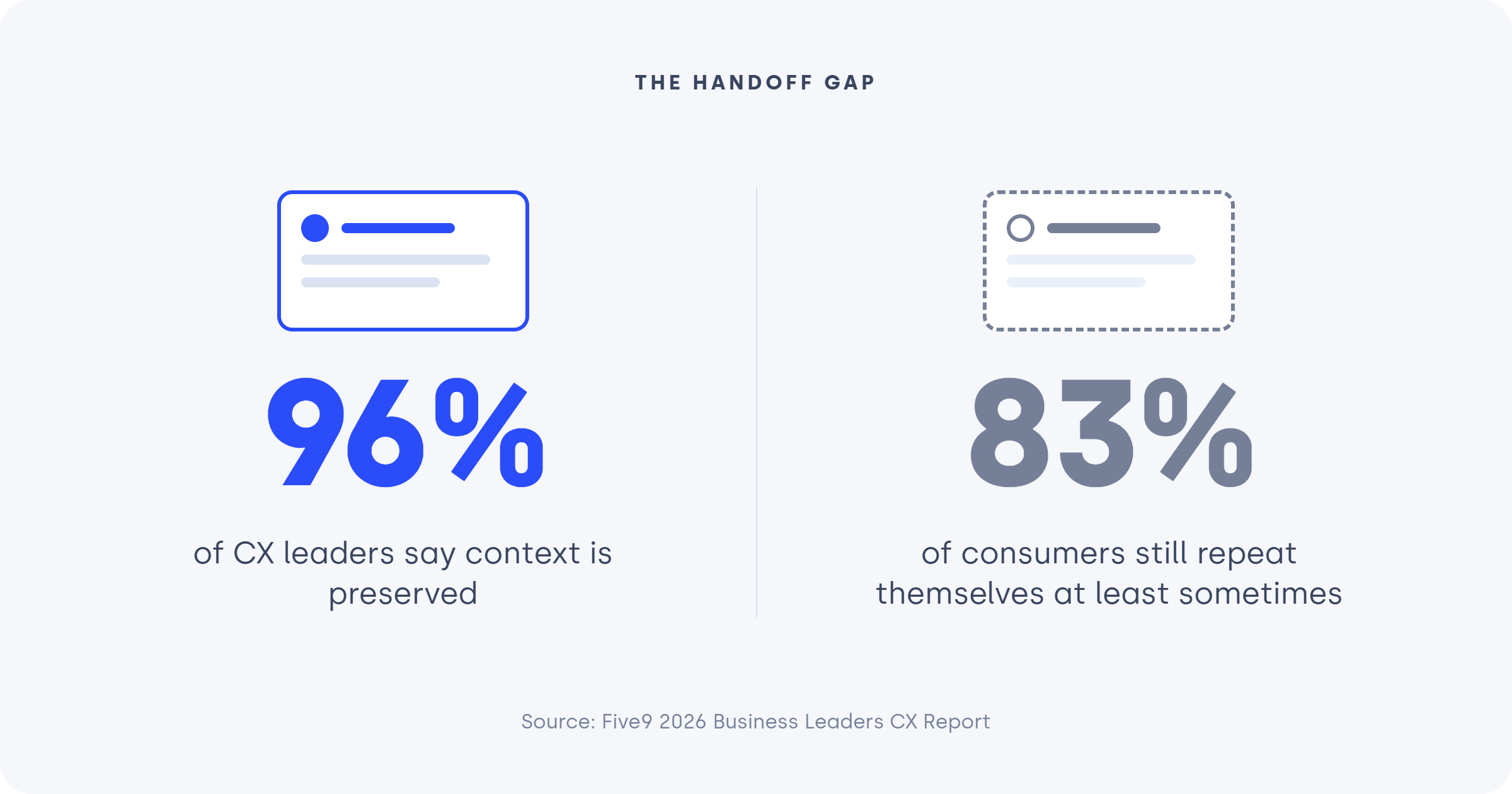
Customers should know when they’re talking to AI and when they’re talking to a person, and the agent who picks up should already know what the customer told the bot. The Five9 2026 Business Leaders CX Report found that 96% of CX decision-makers believe their organizations preserve context when AI hands off to a live agent, yet 83% of consumers say they still have to repeat themselves at least sometimes. That gap is where trust gets lost.
3. Rethink your KPIs
If more conversations reach agents, handle times will go up, and that’s OK. Resolution, retention, and customer lifetime value will tell you much more about whether those conversations are paying off.
This is the thinking behind what we call Humantic CX at Five9: AI and people working together in every interaction, with AI handling the routine and people leading where judgment and empathy matter most. We design the handoff from the start, and what your best agents do every day helps the AI improve over time.
Muse is an early and admittedly messy preview. But the direction is clear. When service gets easier, people use more of it, and the conversations that matter most still end up with a person. The companies that plan for both will be in much better shape than the ones still waiting for AI to shrink the contact center.
Five9 is here to help you drive smarter CX with every interaction. Get started today.