Consumers Aren't Rejecting AI in Customer Service. They're Asking Us to Earn It.

October 14, 2026
Leaders are racing to put AI into customer service. Consumers aren't racing with them. That's the clearest finding in our 2026 Consumer CX Report, built with Hanover Research from a survey of 3,000 consumers in the US, UK and Germany, and it changes how I think about rollout.
Adoption is thinner than it looks
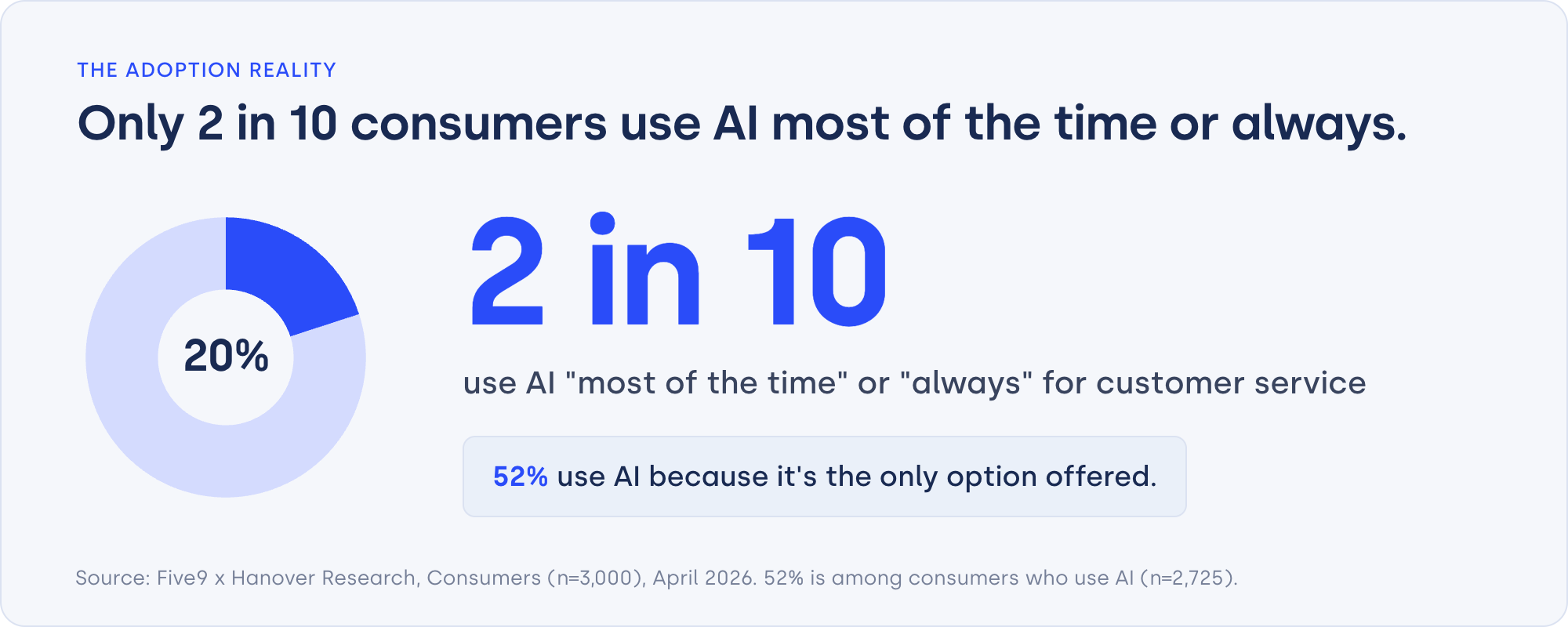
Only 2 in 10 consumers use AI "most of the time" or "always" when they need customer service. When we asked why people use it at all, the top answer (52%) was that it was the only option offered. That isn't adoption. It's a detour.
We also see the gap in how leaders predict behavior. In our parallel survey of business decision-makers, leaders expected Gen Z to pick chatbots and messaging apps first. Gen Z picked phone, live chat and email. Chatbots didn't make their top three.
Trust has a simple lever
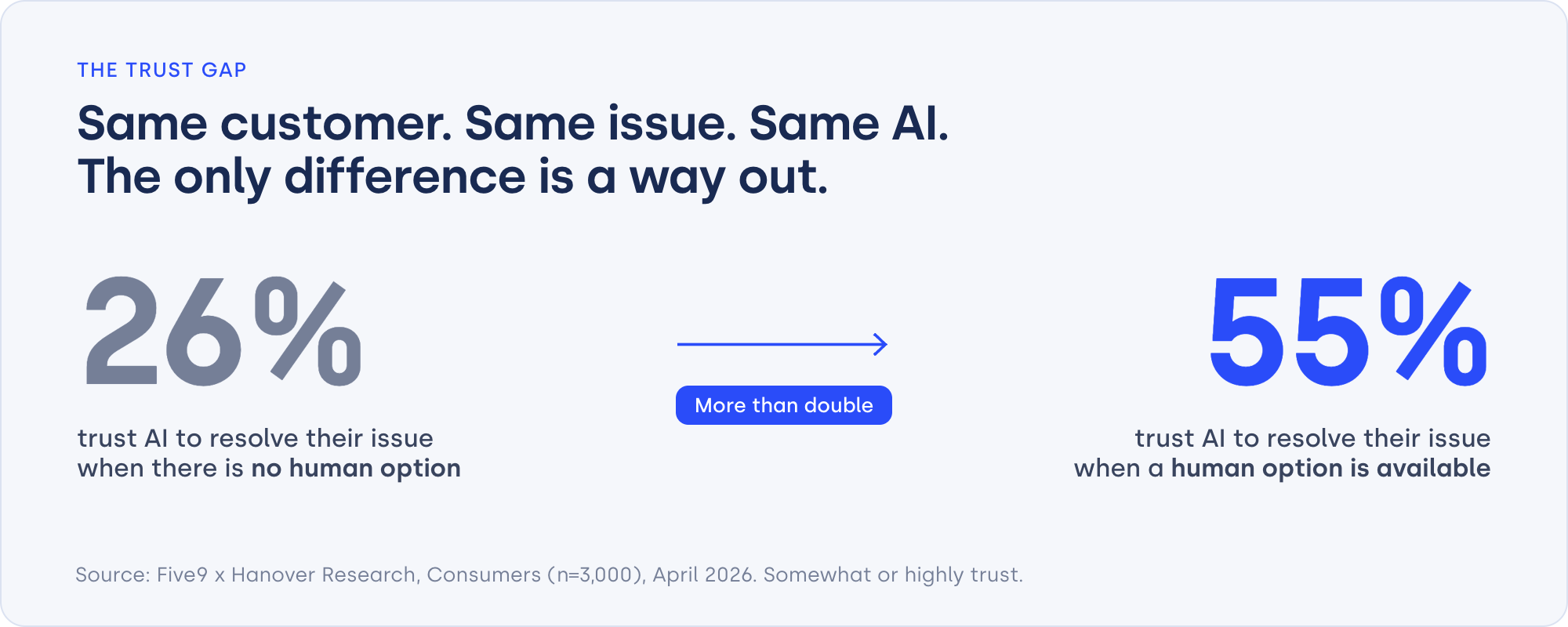
If you remember one number from this report, make it this one. 55% of consumers trust AI to resolve their issue when a clear option to reach a human is available. When there's no human option, it drops to 26%.
Same customer, same issue, same technology. The only difference is whether there's a way out. Transparency works the same way. 71% say it's very or extremely important to know whether they're talking to a bot, and that figure rises with age.
When AI fails, it fails fast
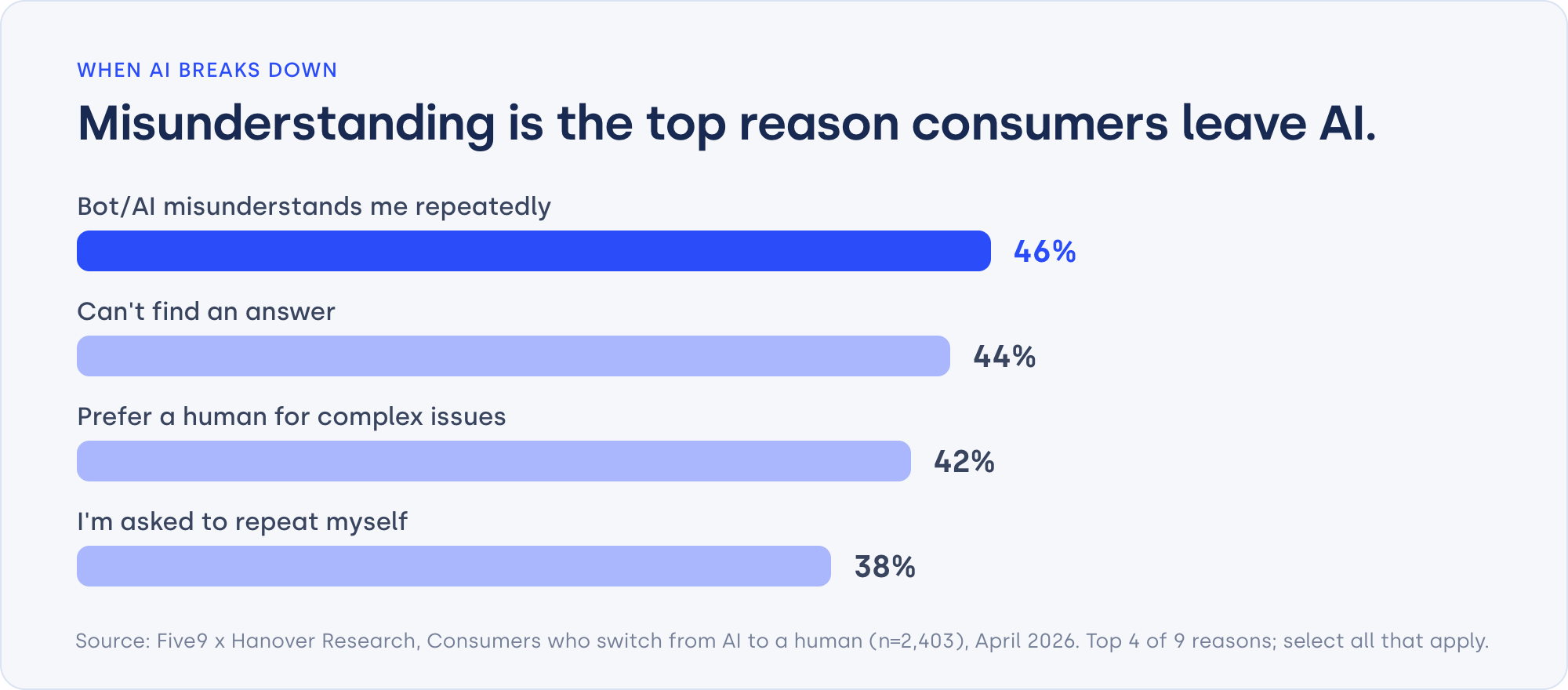
92% of consumers give AI fewer than 10 minutes before asking for a human. Among those who switch, 46% give the same reason: the bot repeatedly misunderstood them.
The handoff is where it gets worse. 35% say they often or always have to repeat themselves after escalating. If you think about it from the customer's side, they've already told their story once, and now they're being asked to tell it again. That's a context problem, and it's solvable.
One strategy won't fit every customer
Attitudes split by generation and by country. Millennials are the most accepting of AI, with 55% calling it useful for customer service, compared with 35% of Baby Boomers. In Germany, only 9% see no benefit to AI in customer service. In the UK, it's 23%. A single playbook across those audiences leaves someone behind.
What I'd do with this
Three things.
- Make the human option visible in every AI experience, even if most people never use it.
- Tell customers when they're talking to AI before they have to ask.
- Carry context through every handoff so no one repeats themselves.
Where to automate first is clearer than how fast to go. More than a third of consumers say AI can handle password resets and order status checks completely on its own. Start there, and use what you learn to earn the next use case.
None of this argues against AI. It argues for sequencing it around the customer's trust instead of our own enthusiasm.
This is the thinking behind Humantic CX, our view of a world where your AI and your people are one team, sharing context and learning from each other. Sometimes AI leads and sometimes a person does, and the two are never working alone.
Download the 2026 Consumer CX Report to see the full findings by generation and country. And to see how business leaders are approaching the same questions, read the Five9 2026 Business Leaders CX Report.