
Why Do Customers Keep Repeating Themselves and What Is It Costing Your Business?

August 22, 2026
We've all been there: you call into a customer support line and hear the familiar, robotic voice ask "How can I help you today? You can say 'Billing,' 'Order Status,' or 'Support.'" You do your best, but ultimately, you'll have to talk to an agent. Then, you hear the dreaded question, "How can I help you today?"
Then, the worst happens: you have to repeat everything you just did all over again.
With all our technological advances — especially with AI agents already being implemented or piloted in 92% of contact centers — why must customers keep repeating themselves? And how can CX leaders fix it?
Why your business keeps "forgetting" your customers
Though it is often misquoted (not to mention misattributed to Albert Einstein), the saying "the definition of insanity is doing the same thing over and over again, but expecting different results" feels incredibly apropos here. Ask your customers to repeat themselves multiple times in a single interaction, and they may feel partially insane by the time they reach the end of it.
Before you can fix the problem, however, it's important to identify why your customers are having to repeat themselves. And unfortunately, the culprit could be one (or more) of many things:
Data silos
Omnichannel customer experience problems (when it comes to requiring information repetition) can often be traced to keeping your data in silos. Social media interactions only reside in the social media platform. Sales data is only kept in the customer relationship management (CRM) system. Support tickets can only be accessed in the ticketing platform. The list goes on.
When each system exists on its own with no integrations or data syncs among them, you're effectively making it much more difficult for your entire organization to know the full history of your customers. And, according to our 2026 Business Leaders CX Report, 34% of consumers reported that context is lost whenever they switch channels.
The AI agent and human agent handoff gap
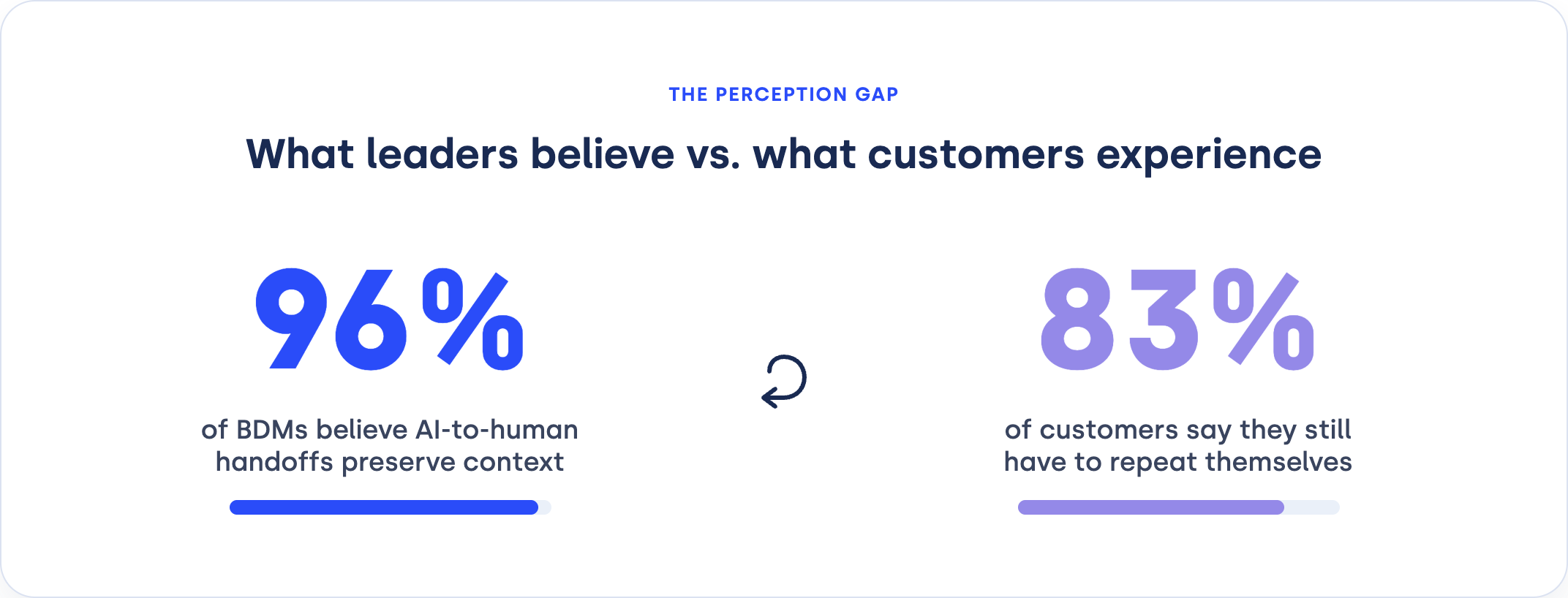
Our report also found that nearly all (96%) business decision-makers (BDMs) in CX believe the handoff between their AI and human agents preserve the necessary context. But 83% of consumers say they at least sometimes have to repeat themselves after being transferred from an AI agent to a human one, making the handoff gap a problem that every organization must address.
Why? 88% of customers reported they were frustrated by the time they switch from an AI agent to a human one, and 1 in 3 rated themselves as very or extremely frustrated. If you want to lower friction in your customer journey and promote customer satisfaction and loyalty, the handoff gap is a good place to start.
Lack of interaction history
With data silos and context loss between agents and channels, another issue rears its ugly head: interaction history. Every piece of missing information requires agents to spend more time asking more questions and increasing customers' frustration levels.
It's important to note the omnichannel customer experience problems here, too. Customer interaction histories are the most powerful when you consider the entire customer journey. Your agents could have an interaction that started out on social media. But they could also be calling in. Not having real-time interaction histories means asking customers the same information time and time again.
Short- and long-term interaction history is also important to keep on your customers. With it, it's not only far easier to identify trends at both a micro and macro level, but it's also critical for keeping all your communications relevant. No one likes getting "Please review our product" after they've returned it. Or promotions about switching to a new service plan after they just did a week ago.
The hidden costs of customers repeating themselves
All the friction points in your customer journey don't just cause your customers problems, they cost your contact center valuable resources, such as:
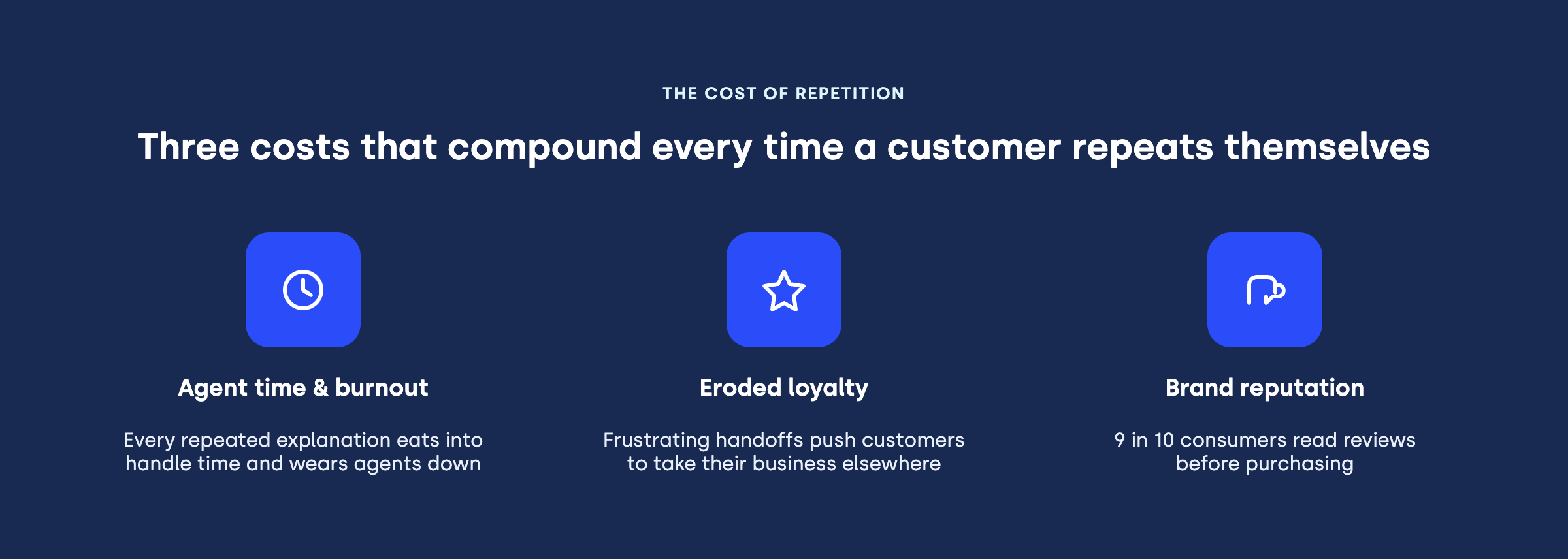
Higher operational costs and agent burnout: Every repeated question asked means more time your agents spend on unnecessary — and, let’s be honest, boring — information gathering. In turn, you waste support hours (and agent cognitive capacity) that could be spent being more productive and on more interesting work.
Eroded customer loyalty and retention: The more frustrated your customers are trying to get support, the less likely they are to reach out again — but also to make repeated purchases. Additionally, you likely lose the opportunity to up- or cross-sell them across your suite of products and services, ultimately reducing revenue.
Brand reputation reduction: Even a single negative review can damage your brand's public perception, especially since 9 in 10 consumers read reviews before making a purchase. Even if your organization responds to negative reviews, the damage is already done and influencing public opinion (and not in your favor).
Fixing your omnichannel customer experience problems
Unfortunately, these situations are just some of the many that could be causing your customers to repeat themselves. Fixing the issue in your own contact center will take a few steps:
First, prioritize monitoring key metrics, such as customer effort score (CES). By asking your customers to measure how easy it is to work with your organization, you can directly highlight issues and address them. Monitoring your CES can help you accurately measure your customers' experience with your organization and work towards reducing your customer effort score.
Next, use your CES and other metrics to identify friction points throughout your customers' journey. Pay special attention to "channel hopping" behavior, where customers may start on one channel and switch to another before getting their issue resolved. It may be helpful for you to send "test" customers through your support channels to test them out and see where you ask for information — and where those questions are redundant. Sentiment analysis can also be of use here. The more frustrated customers are, the likelihood something's gone wrong in your workflows.
Finally, integrate all your data and systems together with an intelligent CX platform. These platforms can help you eliminate your data silos and offer true, frictionless omnichannel customer service: seamlessly pick up conversations across channels, have full customer interaction histories, and solve customers' issues the first time, without repeatedly asking for the same information.
Using AI to streamline the journey and ease customer frustration
Building your AI-powered contact center — one where customers don't have to repeat themselves — means understanding your customers at the deepest level. The more you know about their preferences and tendencies, the better off your contact center will be.
Today, that means CX leaders are figuring out their AI playbook: where AI can help streamline the journey, ease customer frustrations, and improve agent productivity and engagement. However, the playbook for AI in CX is far from defined.
Get the inside scoop on what CX decision-makers and consumers are thinking about AI in CX with the 2026 Business Leaders CX Report, and write your playbook today.