
The Hidden Cost of System-Switching: How Frontline Friction Quietly Erodes CX

June 26, 2026
Customer effort is usually measured from the customer’s perspective. How easy was it to get help? How quickly was the issue resolved? Did they have to repeat themselves? But customer effort often starts somewhere else: with the tools agents use every day.
Think about a typical support interaction. A customer calls with a question about an order. To answer it, the agent checks the CRM, searches a knowledge base, reviews previous interactions, and updates a ticket before ending the conversation.
None of this is unusual. In many contact centers, it’s simply how work gets done.
The problem is that every system switch takes time. A few seconds to find the right screen. A few more to search for information. Another few to copy details from one application to another. On their own, these moments seem insignificant. Across hundreds of interactions a week, they’re anything but.
What customers experience as waiting, repeating information, or being placed on hold is often the result of agents having to navigate technology rather than focusing on the conversation.
The cost shows up everywhere
The impact of system-switching shows up in the metrics contact centers care about most.
When agents work across multiple applications, average handle time (AHT) increases because information takes longer to find. First contact resolution (FCR) suffers when customer context is spread across systems. Training takes longer because new hires must learn multiple tools and workflows before they can become productive.
Over time, these small inefficiencies compound. And for CX leaders, the result is familiar: longer wait times, higher customer effort, lower productivity, and a more frustrating experience for employees and customers .
Consider an agent who spends just 10 seconds moving between applications four times during a customer interaction. That's 40 seconds of added effort per conversation. In a contact center handling 5,000 interactions a day, that translates into more than 55 hours of agent time spent simply navigating systems rather than helping customers.
How we ended up with tool sprawl
Of course, contact centers didn’t set out to create fragmented ecosystems.
Over time, new tools were added to solve specific problems.
One vendor handled voice. Another managed chat. A third supported workforce engagement. Additional platforms were introduced for CRM, analytics, quality management and AI.
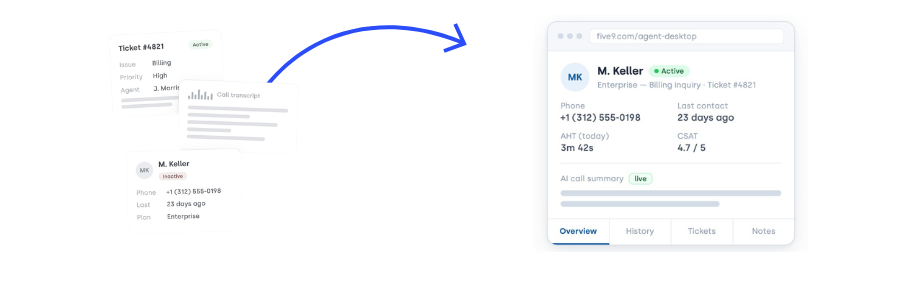
Each decision made sense on its own. The challenge emerged over time. As more systems were added, agents became responsible for stitching them together. Instead of technology simplifying work, work increasingly revolved around navigating technology.
What happens when friction is removed
Apex America encountered this challenge as it prepared for growth. The company, which handles approximately 12,000 customer interactions per day, was operating across multiple vendors and disconnected systems. Making changes required significant development effort, and managing the environment added complexity and cost.
To support its expansion plans, Apex consolidated onto a single platform, simplifying operations and giving agents a more unified experience. The company implemented the new environment in just two weeks, creating a foundation that could scale without adding more complexity.
And the benefits of reducing frontline friction can be significant.
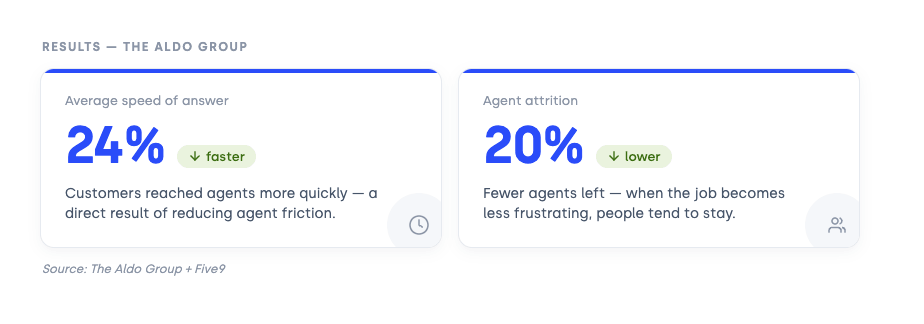
At The Aldo Group, simplifying the agent experience contributed to a 24% reduction in average speed of answer and a 20% reduction in agent attrition. The lesson is simple: when it’s easier for agents to do their jobs, customers tend to get better service.
AI can’t eliminate friction if workflows remain fragmented
Many organizations are investing heavily in AI to improve efficiency and customer experience.
AI can certainly help. It can summarize conversations, surface knowledge, automate routine tasks and assist agents in real time.
But AI doesn’t eliminate the cost of disconnected workflows. In fact, AI often makes the importance of a unified environment even more apparent. AI is most effective when it has access to customer context and can take action across systems. When data is fragmented and workflows remain disconnected, AI spends much of its time compensating for complexity rather than removing it.
Organizations may see incremental gains, but they often miss the larger opportunity to simplify the agent experience at its source.
So — before organizations ask how AI can make agents more productive, it’s worth asking a simpler question: how much time are agents spending just moving between applications?
The next frontier of customer effort reduction
Customer effort isn’t created only in the customer journey. Often it’s created behind the scenes, in the systems agents use every day.
Reducing effort doesn’t always require another tool, another workflow, or more automation. Sometimes it starts by removing the friction that’s already there.
And while customers may never see the systems agents use, they feel the impact of them in every interaction. Faster answers, fewer transfers, and less repetition all contribute to a smoother experience — and ultimately higher customer satisfaction.