Five9 Epic Integration: Faster, Connected Healthcare CX

August 11, 2026
A patient calls to refill a prescription.
Five minutes later, they're still answering verification questions.
Ten minutes later, they're explaining that they also need to reschedule a follow-up appointment. The agent places them on hold while searching for information in another system. A transfer follows. Then a follow-up task. The patient hangs up unsure whether anything was actually completed.
It's a familiar scenario in healthcare. And when multiplied across thousands of patient interactions every day, it becomes a significant operational challenge.
Healthcare leaders understand the stakes: every abandoned call, delayed refill, missed appointment or frustrated patient affects access to care, workforce productivity, revenue and, in some cases, patient outcomes.
Patients also expect healthcare communication to feel as seamless as the experiences they receive from banks, airlines, retailers and digital-first companies. According to a recent report, 69% of patients would switch providers for a better experience, while Accenture found that negative phone interactions make patients four times more likely to switch healthcare organizations.
Yet many providers are trying to meet those expectations with disconnected systems and workflows that were never designed for modern patient engagement.
That is why the Five9 Epic integration is turning heads: healthcare organizations are moving it into live deployment at an unusually fast pace.
The growing healthcare CX challenge
Healthcare contact centers are the front door to the patient experience. They handle scheduling, prescription refills, billing questions, referrals and care coordination, fielding everything from medication interaction questions to insurance coverage and where to find an in-network specialist. These and countless other interactions directly shape how patients perceive their provider.
But healthcare does not operate like other industries. Patients may be dealing with sensitive medical concerns, complex diagnoses or urgent care needs. Digital channels continue to grow, but according to Five9 2026 Business Leaders CX Report, patients still prefer speaking with a live person about 30% of the time — more than any other channel — and 50–60% of inbound healthcare calls involve appointments or prescription refills.
At the same time, healthcare organizations face staffing shortages, rising call volumes, administrative overload and pressure to improve service without adding headcount.
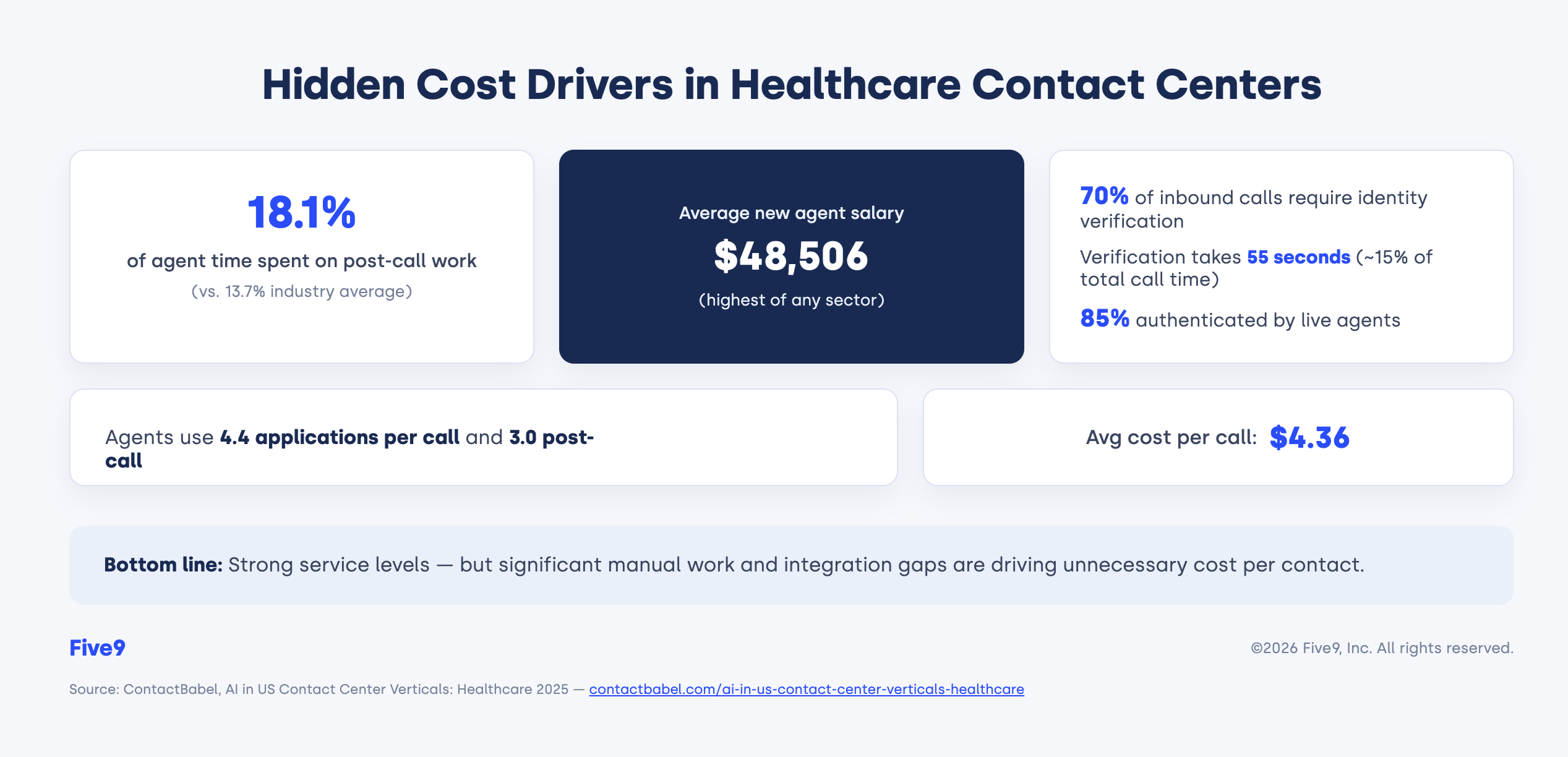
The burden shows up in agent workflows. According to ContactBable, 18.1% of agent time spent on post-call work and 70% of inbound calls requiring identity verification, agents have less time to focus on helping patients.
The Five9 CX Report 2025 found that 26% of healthcare respondents cited a lack of useful systems and tools, such as a single agent desktop, as a contributor to agent frustration and turnover.
At the root is a familiar problem: fragmented workflows. Patient communications and patient records often live in separate systems, forcing agents to verify identities, search across applications and create follow-up tasks manually.
Even when Epic serves as the system of record, contact center work can still require extra clicks, transfers and manual updates. Each one adds time, delay and friction – not to mention aggravation for both patients and agents.
What does a fragmented patient interaction look like?
Consider a common scenario involving a prescription refill and an appointment reschedule.
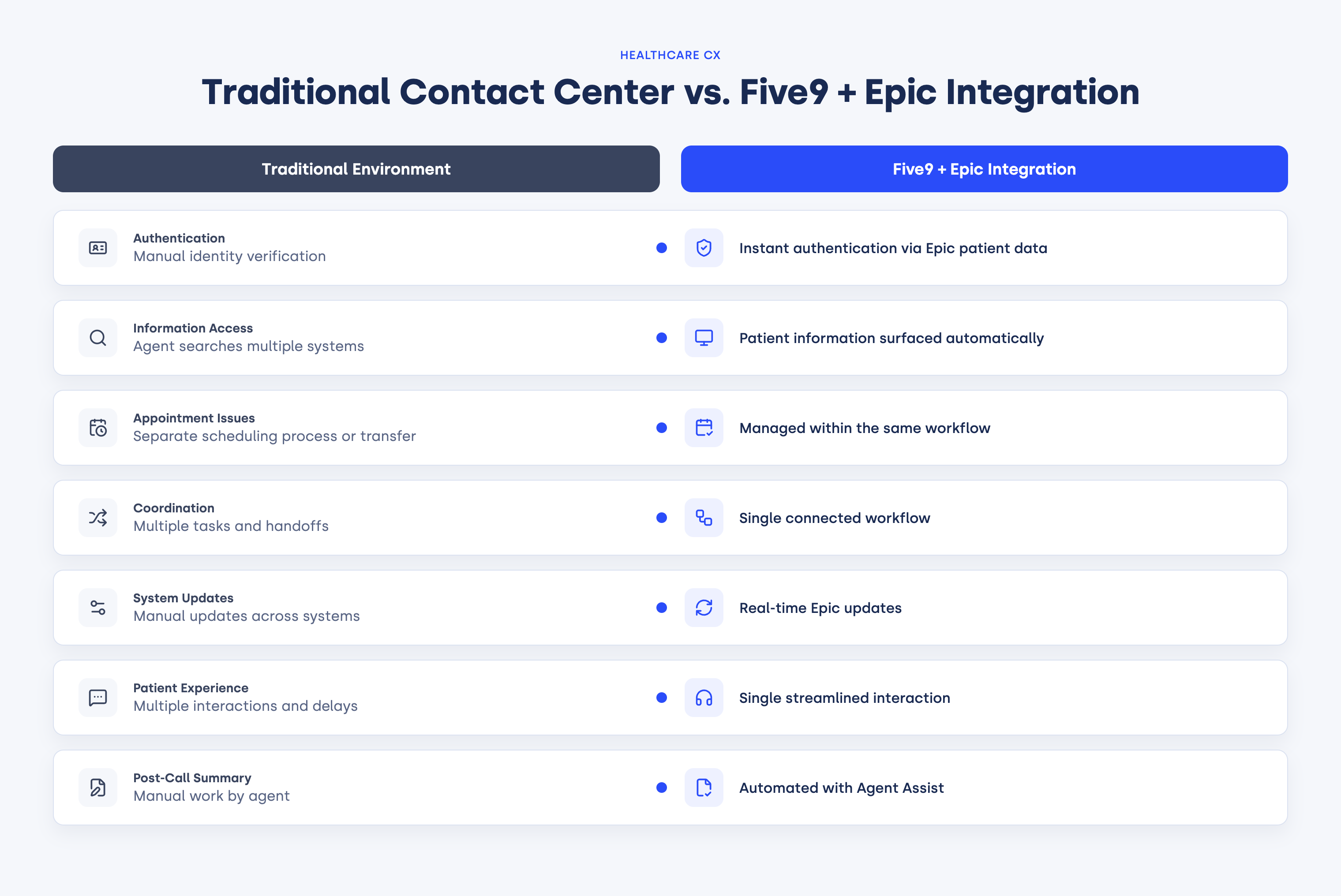
Without contact center and Epic integration, agents and patients navigate separate systems, creating slow, repetitive handoffs. With the Five9 Epic integration, authentication, refills, appointment changes and record updates can happen in a single, uninterrupted flow.
Bringing the contact center into Epic
Five9 embeds contact center tools like click-to-dial, single sign-on and screen pops directly inside Epic modules such as Hyperspace and Cadence. Agents work in one interface instead of switching systems.
That supports the “Epic First” strategy many health systems now pursue: maximizing their Epic investment while minimizing middleware, extra screens and outlier costs.
The integration is embedded directly within the Epic environment and can work inside applications such as Cheers, Hyperspace, Cadence and other Epic modules, giving agents access to Five9 capabilities such as click-to-dial, single sign-on and embedded call controls directly into Epic workflows, through a single interface.
Then a call arrives, relevant patient information appears through Epic-native screen pops. Appointment history, prescription information, insurance details and previous interactions are immediately available, reducing the need to search across systems.
Five9 Epic Orchestrator, providing AI-powered self-service, extends that value by connecting patient interactions directly to the Epic workflows that complete them. Instead of relying on manual follow-up, organizations can use AI-powered self-service to reduce callbacks, delays and dropped handoffs.
Agent Assist also works within Epic workflows, giving agents next-best recommendations, compliance reminders and more, while helping reduce after-call work.
The opportunity extends beyond inbound requests. As healthcare organizations focus on population health, care coordination and reducing patient leakage, proactive outreach is becoming increasingly important.
With Five9 integrated into Epic, organizations can identify patients who need follow-up care, prioritize outreach campaigns and communicate through voice, SMS or email based on patient preferences.
The results are significant. One large health system reported a 25% improvement in call handling efficiency after implementing screen pops and click-to-dial in Epic Hyperspace, while another reported a 10% reduction in handling time with the Five9 Fusion Epic Adapter.
The story behind the story: Speed
Healthcare technology deployments are not known for moving quickly. Epic integrations often require extensive testing, workflow validation, stakeholder alignment and careful change management before they reach production.
That is what makes the Five9 rollout noteworthy.
After receiving Epic accreditation in July 2025, Five9 had three healthcare organizations live on the Five9 Epic Adapter within roughly ten months, and two also implemented Epic Orchestrator self-service capabilities.
In healthcare, that is unusually fast. Today, approximately 250,000 inbound calls per month flow through the Five9 Epic integration, and adoption continues to grow.
In a market known for lengthy deployment cycles, that adoption speaks to both the robustness of the integration and the demand for solutions that improve patient engagement without disrupting the Epic environment healthcare organizations already depend on.
The takeaway
Fragmented systems slow everyone down. Agents lose time verifying identities, searching across applications and creating manual follow-ups, and patients feel every extra minute of it.
The Five9 Epic integration closes that gap by bringing click-to-dial, single sign-on, screen pops, AI-powered self-service and Agent Assist directly into Epic, so agents can work from one screen.
The results show up fast: health systems report up to a 25% improvement in call handling efficiency and a 10% reduction in handling time, with three organizations live within roughly ten months of Epic accreditation.
The future of healthcare CX depends on how well organizations connect patient engagement, workforce efficiency and clinical workflows.
Healthcare organizations do not need more standalone applications or additional screens. They need proven technology that works within the systems clinicians and staff already use.
The speed of adoption suggests many providers recognize the same reality: improving patient experience increasingly begins with improving the systems that support it.
Join our upcoming webinar
To explore these challenges in greater depth, join the upcoming Five9 webinar, No More Friction: Five9 Epic Fusion and the Future of Intelligent Patient Access.
The session will examine how embedding Five9 contact center capabilities, AI, automation and proactive outreach into Epic workflows improves access, reduces friction and creates more connected patient experiences.