Healthcare’s CX Problem Is Now a Care-Access Problem

November 19, 2026
Healthcare customer service friction used to cost you satisfaction scores. Now it costs patients their care.
New Five9 research finds that 44% of consumers have delayed or abandoned a healthcare-related action because dealing with a provider was too difficult, time-consuming or frustrating. They stopped trying to schedule an appointment. They gave up on a billing or insurance issue. They put off care. Nine percent switched providers altogether.
We call this the care-completion gap: the share of patients who start a healthcare task, such as scheduling, billing or insurance, and never finish it because service was too hard. It is not a service metric. It is a care-access metric, and it belongs on the same dashboard as no-show rates and patient leakage.
Key findings
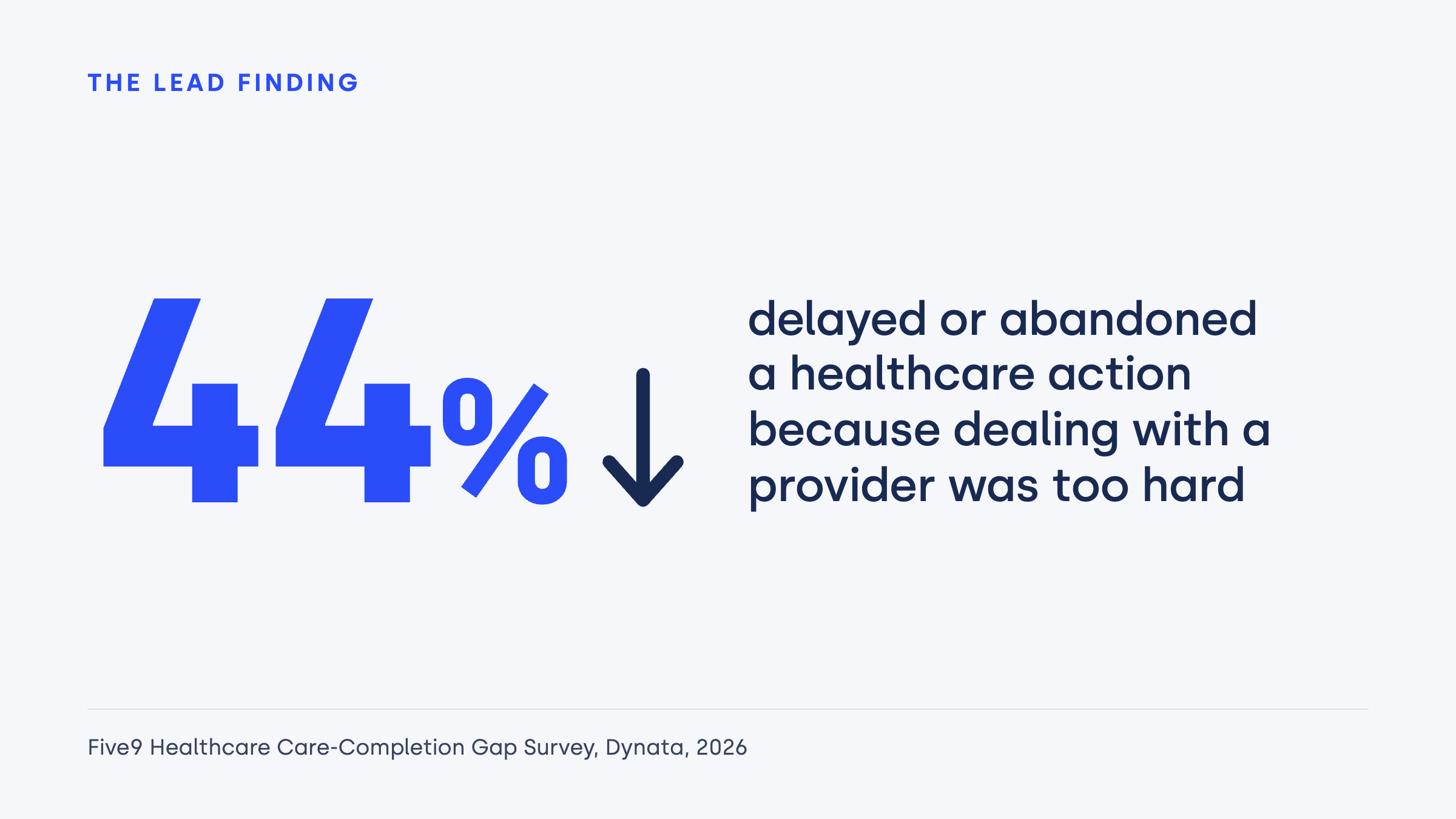
44% of consumers delayed or abandoned a healthcare action because dealing with a provider was too difficult, time-consuming or frustrating.
Only 46% say their issue was fully resolved on first contact (74% of Baby Boomers vs. 26% of Gen Z).
85% expect agents to have access to at least some of their prior interactions, yet 53% still have to repeat themselves at least sometimes.
38% are comfortable using AI to schedule or reschedule an appointment, but only 12% are comfortable using it for medical advice.
The top factor that would increase trust in a healthcare AI interaction is the ability to easily reach a human (39%).
Which patients are most likely to give up on care? Gen Z, by a wide margin
The friction doesn’t land evenly. Among Gen Z, 34% stopped trying to schedule an appointment and 34% stopped trying to resolve a billing or insurance issue. Among Baby Boomers, those numbers are 6% and 4%.
| Behavior | Gen Z | Baby Boomers |
| Stopped trying to schedule an appointment | 34% | 6% |
| Stopped trying to resolve a billing or insurance issue | 34% | 4% |
| Report none of the behaviors asked about | 35% | 83% |
| Issue fully resolved on first contact | 26% | 74% |
Just 35% of Gen Z and 40% of Millennials report none of the behaviors we asked about, compared with 83% of Boomers.
These are the patients who will shape your volume, your loyalty and your reputation for the next 40 years. Right now, many of them are quietly walking away.
How often do patients get issues resolved on the first contact?
Only 46% of consumers say their issue was fully taken care of the first time they reached out. The generational divide is stark: 74% of Boomers report first-contact resolution, compared with just 26% of Gen Z.
What happens to the rest?
17% had to reach out again.
17% were transferred or bounced between people and departments (26% of Gen Z).
9% never got it resolved and gave up.
Every extra touch is another chance for a patient to decide it’s not worth it.
Why do patients still have to repeat themselves?
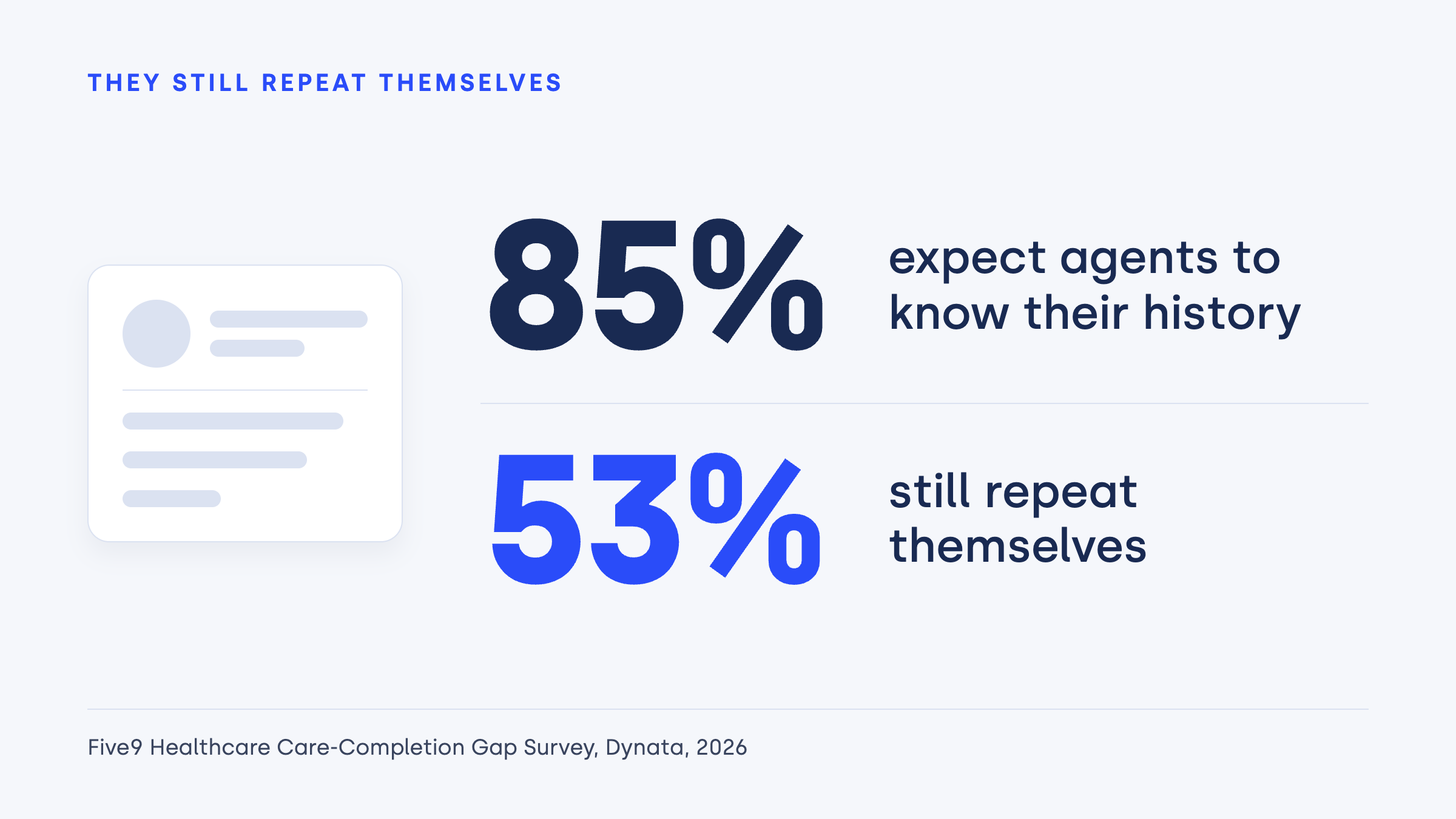
Patients assume you already know them. Eighty-five percent of consumers expect healthcare agents to have access to at least some of their previous interactions and relevant information. Nearly half (49%) expect agents to see all of it. Yet 53% say they still have to repeat themselves at least sometimes, and 14% say they do it often.
Here’s the part that should get a technology leader’s attention. This isn’t a data problem. Your organization already holds scheduling history, billing records, portal activity and prior contacts. It’s an action problem: that context isn’t in front of the agent, or the AI agent, at the moment the patient reaches out. That’s an integration and orchestration challenge, not a staffing one.
Case study: how Lumexa Imaging closed the context gap with Five9
Lumexa Imaging shows what changes when that gap closes. Its IVR offered eight options and misrouted 6,500 calls a month, and agents struggled to authenticate 80% of patient calls because they lacked real-time data.
After moving to Five9 AI Agents for routing and connecting Five9 to Salesforce so patient data reaches the agent as the call arrives, Lumexa Imaging saw ROI within 30 days.
336,000 more calls handled (a 25% increase)
Abandonment kept under 4%
22 seconds cut from average handle time
Savings Murphy puts at the equivalent of 15 full-time employees
Where are patients comfortable with AI in healthcare?
Patients aren’t rejecting AI. They’re drawing a line.
It’s tempting to read healthcare consumers as AI-averse. The data says something more useful.
| Use of AI | Share of Consumers |
| Comfortable using AI for medical advice about symptoms, a diagnosis or treatment | 12% |
| Comfortable using AI to schedule or reschedule an appointment | 38% |
| Prefer AI, or would use it, if it means shorter wait times | 58% |
| Gen Z who prefer AI whenever it is available or whenever it is faster | 44% |
Only 12% are comfortable using AI for medical advice about symptoms, a diagnosis or treatment. But 38% are comfortable using it to schedule or reschedule an appointment, and 58% say they prefer AI or would use it if it means shorter wait times. Among Gen Z, 44% prefer AI whenever it’s available or whenever it’s faster.
The clearest signal is about trust. The number one factor that would increase trust in a healthcare AI interaction is the ability to easily reach a human (39%). That outranks knowing personal and health information is secure (29%) and confidence that the answers are accurate (29%). Among Boomers, it’s 50%.
Patients will let AI handle the administrative work. They want a clear, easy exit to a person, and they want that person to already know what just happened.
How can healthcare leaders close the care-completion gap?
Closing the care-completion gap means treating the contact center as more than a place where interactions get handled. It becomes an intelligence center: one that brings together patient history, real-time context, AI and human expertise to understand why someone is reaching out and resolve it before friction turns into a barrier to care.
For leaders deciding where to invest, we’d start here:
Bring context to the moment of contact. Unify the history that already exists across scheduling, billing, portal and prior contacts so every agent and AI agent sees why the patient is calling.
Put AI where patients trust it. Scheduling, rescheduling, records requests and routing are where patients are already comfortable. Keep symptoms, diagnosis and treatment with clinicians.
Design the handoff, not just the bot. Make reaching a person easy, and make sure the context travels with the patient so no one starts over.
Build trust in from day one. Security and accuracy are top trust drivers for roughly three in ten consumers. Governance, visibility into what AI says and clear disclosure are part of the experience, not an afterthought.
Measure completion, not containment. Containment tells you what the AI deflected. Completion tells you whether the patient got what they came for.
The business case is not only about patient experience. When Lumexa Imaging applied the same approach to outbound appointment reminders, 75% of outbound calls moved to the Five9 Dialer, cutting 4.5 minutes per call and $400K a year in labor cost. Murphy credits a 24% higher appointment conversion rate with $4M in revenue the organization would not otherwise have captured. Better access and better economics turned out to be the same project.
Five9 helps healthcare organizations bring customer history, real-time context, AI and human expertise together, so more patients get what they need on the first try. Smarter CX with every interaction starts with making sure no patient has to give up to get care.