How Healthcare Leaders Use AI to Improve Patient Experience

October 15, 2026
Healthcare CX leaders are under more pressure than ever to deliver care that’s connected, efficient and compassionate:three things that don’t usually show up together when you’re working with legacy contact center infrastructure built for a different era of patient expectations.
That tension was the premise behind a roundtable at Five9 CX Summit 2025, where healthcare leaders came together to talk candidly about what’s working, what isn’t and how they’re adjusting course. Rather than recap that session point for point, I wanted to reflect on the questions raised in that room and ask a different one: what are we seeing across the healthcare industry right now, and what does it tell us about where CX is headed?
Four levers kept surfacing throughout the conversation: artificial intelligence (AI) and automation, omnichannel engagement, workforce empowerment and operational efficiency. Here’s what each one means in practice:for patients, for agents and for the leaders footing the bill.
Where AI actually earns its place in patient engagement
Ask any healthcare contact center leader where the friction lives, and the list is familiar: long hold times, missed appointment reminders, no good after-hours option, agents stretched too thin to keep up with volume and the quiet revenue leakage that comes from all of it.
These aren’t new problems. What’s changed is that AI finally offers a credible fix for them, not by replacing the people who answer the phone, but by clearing the backlog of routine work that keeps them from focusing on patients who need more than a scheduling change.
This is where Five9 Voice AI Agents fit into the picture. They don’t try to be a digital version of a nurse or a provider. They handle the repeatable work — confirming an appointment, answering a billing question, routing an after-hours call to the right place — so human agents spend their time on the conversations that actually need a human. Patients still prefer speaking with a live person about 30% of the time, more than any other channel, and roughly 50% to 60% of inbound healthcare calls involve appointments or prescription refills,which tells you exactly where automation should focus first.
For patients, that means shorter waits and fewer dead ends. For the organization, it means fewer missed appointments and less revenue quietly slipping through the cracks.
Five9 Fusion for Epic shows what this looks like once it’s live. By embedding contact center capabilities directly into modules clinicians already use, health systems have reported up to a 25% improvement in call handling efficiency and a 10% reduction in handling time,without asking agents to learn a second system. It’s also helping healthcare organizations fast-track Epic’s Gold Stars recognition simply by routing calls through Epic Cheers the way they’re already supposed to.
What “lessons learned” usually means in practice
Every success story skips the middle part. The change management, the integration headaches, the weeks where the new workflow was slower than the old one before it was faster. That middle part is where most of the real lessons live.
The organizations that pivot well tend to share two habits. First, they recognize the value of the investment early, before the rollout is finished, so momentum doesn’t stall waiting for a perfect launch. Second, they prioritize ease of integration with their existing electronic health record and technology stack over building something impressive but disconnected.
Christian Healthcare Ministries (CHM) is a useful example of what happens when that second habit is missing at the start. Before its transformation, the organization’s systems — or the lack of them — were maxed out, which is a familiar starting point for any healthcare contact center bracing for growth it isn’t yet equipped to handle. The full story of how CHM rebuilt its member experience is worth reading for exactly this reason: it doesn’t skip the hard part.
Bringing the workforce along
Every technology rollout lives or dies on adoption, and healthcare has less room for error than most industries. Burned-out staff won’t tolerate a clunky system, and patients notice immediately when an agent is fighting their own tools instead of helping.
The healthcare organizations seeing AI stick,not stall,treat it as a trust-building exercise, not a mandate. That means showing agents what the technology does for them before asking what it expects of them.
CHM’s experience is a clear illustration. Instead of routing every caller through a long, confusing menu, the team gained the ability to identify members and their status before an agent even said a word, connecting people to the right specialist without the guesswork. That freed-up capacity didn’t just improve efficiency — it gave the team room to place outbound welcome calls to new members and offer prayer calls to those navigating difficult health journeys.
That’s what workforce empowerment actually looks like: automation clearing space for the parts of the job that drew people to healthcare in the first place. For agents, that’s the difference between feeling replaced and feeling supported.
Making the business case
Every healthcare CX leader eventually has to answer the same questions from leadership: what’s the payback period, does this reduce headcount or let existing staff handle more, how risky is the migration, and what’s the timeline — 6 months, 12 or 18?
A credible answer doesn’t lean on generic efficiency metrics. It ties directly to patient access, staff retention and cost-to-serve, because those are the terms healthcare leadership actually budgets against. Speed matters too: Epic integrations have a reputation for lengthy rollouts, but three healthcare organizations went live on the Five9 Epic Adapter within roughly 10 months of Epic accreditation, a timeline that gives leadership something concrete to measure against instead of an open-ended promise.
For the C-suite, that’s the difference between a project that gets funded and one that stays a slide deck. If this is the conversation you’re having internally, HIPAA-compliant software for healthcare and the Five9 Fusion for Epic integration are good starting points for what a realistic scope and timeline actually look like.
What success looks like
The metrics healthcare CX leaders are tracking now cluster into a few consistent categories: appointment bookings, answer rates, agent performance and patient or provider satisfaction.
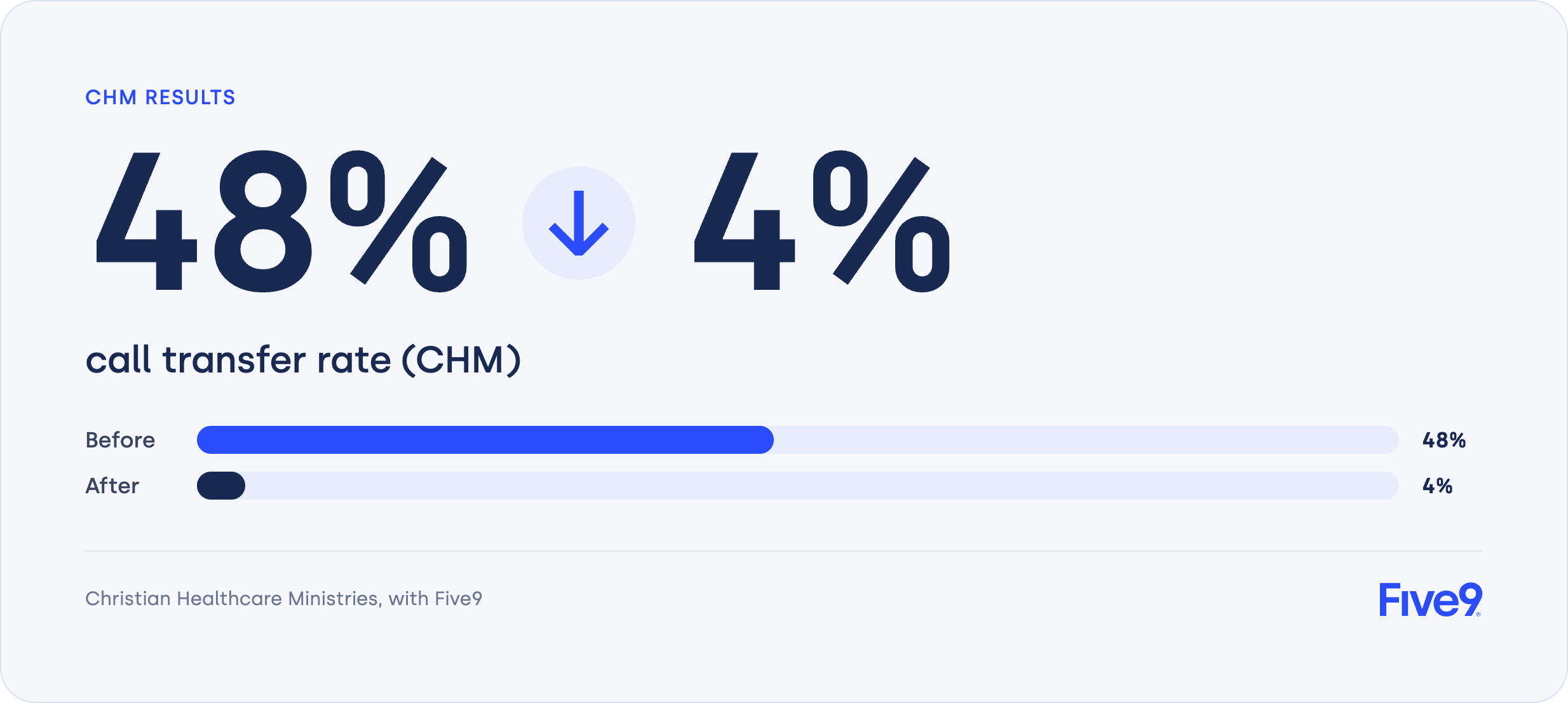
CHM’s numbers are a good reference point for what “working” looks like in practice: call transfer rates dropped from 48% to 4%, and intelligent routing now identifies roughly 80% of inbound calls before an agent even picks up. Metrics like these matter because they’re not abstract — they translate directly into shorter waits, fewer repeated conversations and agents who spend more time solving problems than routing calls.
Key takeaways
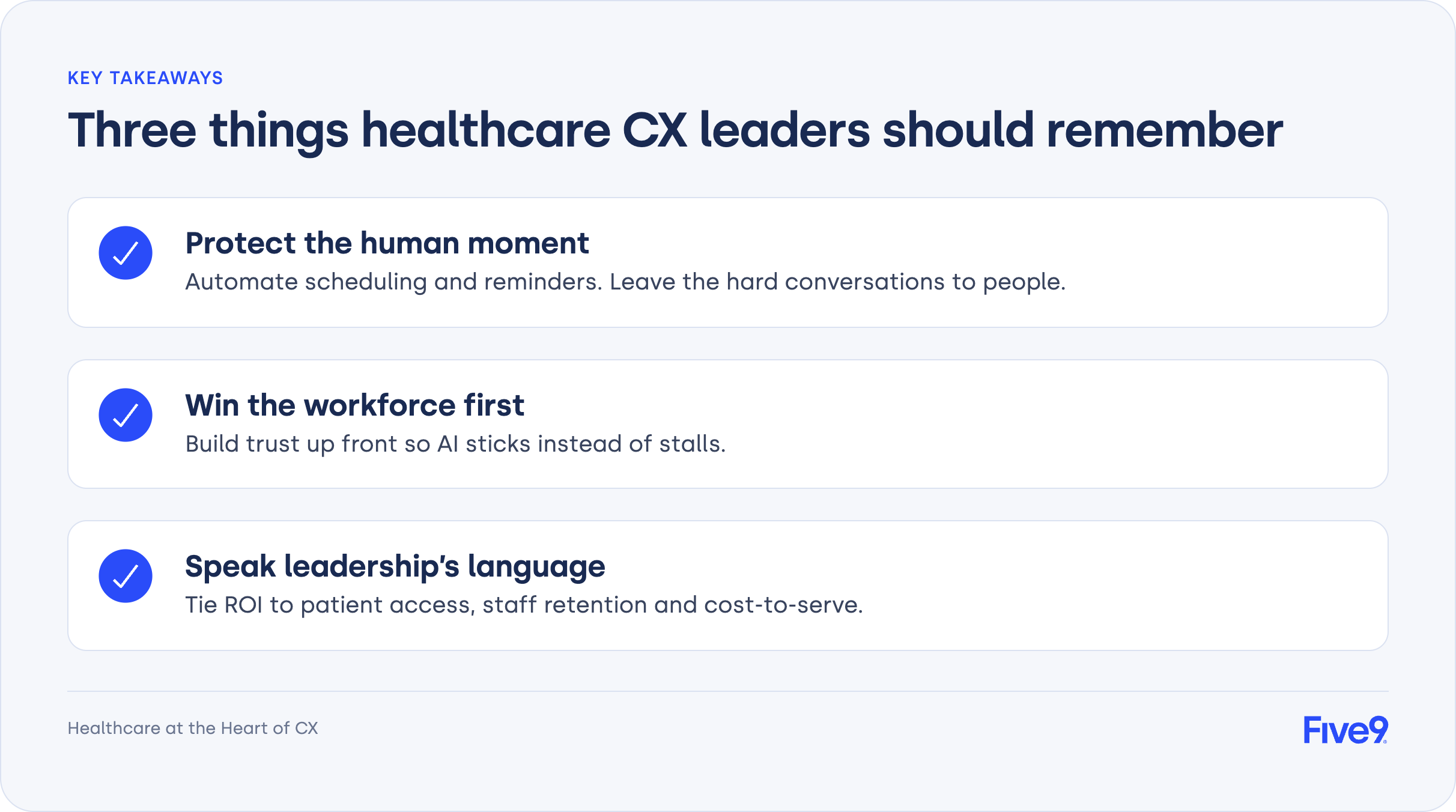
Three implications stand out for healthcare CX leaders:
AI only works in healthcare CX when it protects the human moment rather than replacing it. Automate the scheduling and the reminders. Leave the hard conversations to people.
The workforce conversation determines whether AI sticks or stalls. Building trust up front gets teams to full productivity faster and makes the gains durable.
ROI has to speak leadership’s language. Tie the business case to patient access, staff retention and cost-to-serve,not generic efficiency numbers that don’t land with healthcare executives.
The connecting thread across all three: the healthcare organizations seeing real results treat CX transformation as a change-management problem as much as a technology one. Get the human side right, and the technology has a real chance to deliver.
To satisfy the patient, the agent and the C-suite all at once isn’t easy,but it’s exactly what Five9 Fusion for Epic was built to do. Ready to streamline patient engagement? Read the eBook to learn more.