How Retail Contact Centers Are Using AI: 2026 CX Report Findings

November 18, 2026
Retail leaders are using AI to fix problems they already had: seasonal staffing swings, compliance, and multilingual support. In Five9 2026 Business Decision Makers CX Report built with Hanover Research, told us. The report surveyed 600 leaders across the US, UK and Germany.
Every retail leader knows the rhythm. Holiday peaks swamp the queue. Returns season hits right after. Customers write in from three countries and four languages and every conversation has to stay compliant.
We surveyed 600 leaders across the US, UK and Germany for our 2026 Business Decision Makers CX Report, built with Hanover Research. For retail customer service, we expected the usual story about chatbots and shiny pilots. That isn’t what the 120 retail leaders in our study told us. They’re pointing AI at the problems they already had, and they were candid about what’s working and what isn’t.
Three findings stand out.
1. Where is retail using AI in the contact center?
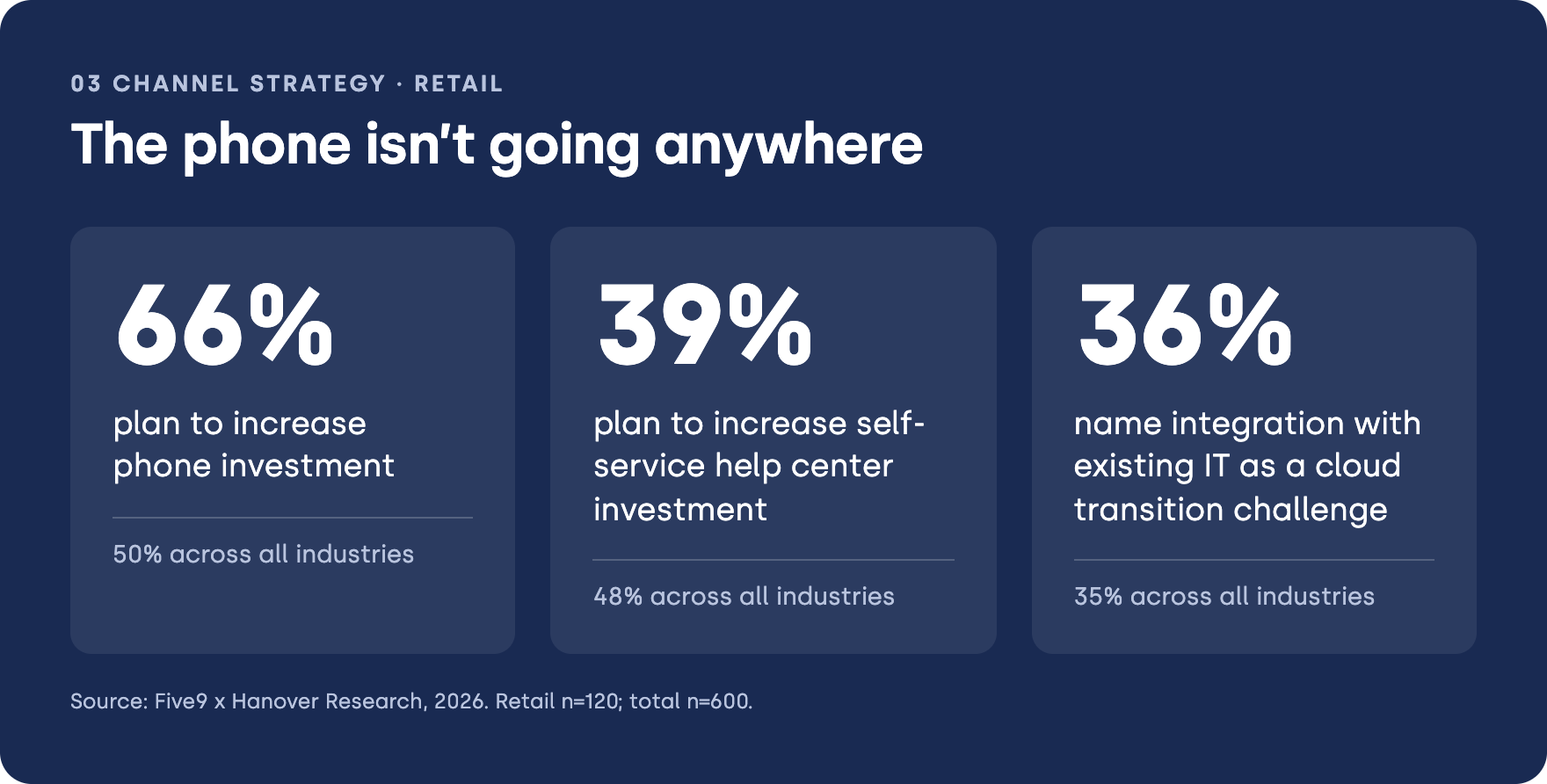
Look at where retail leaders have put AI to work. Nearly half (47%) use it for workforce management and forecasting, compared with 36% across all industries. Another 48% use it for real-time compliance monitoring, compared with 39% overall. On both, retail is ahead of Financial Services, Healthcare and Travel/Hospitality.
| Use case | Retail | All industries |
|---|---|---|
| AI for workforce management and forecasting | 47% | 36% |
| AI for real-time compliance monitoring | 48% | 39% |
| Real-time translation reduced agent workload | 58% | 47% |
That list looks different from other sectors because retail’s pressures look different. Demand swings by the season. Labor is a major cost. Compliance rules follow every interaction, whether it’s a loyalty program question or a return across borders. Contact center forecasting helps leaders put the right number of people on the schedule before the surge hits. Contact center compliance monitoring catches issues while the conversation is still happening, not after the fact.
Picture a Monday in January. Returns are stacking up, half your seasonal hires are still learning the systems and a new promotion has just changed the policy language agents need to use. This is where operational AI earns its place. It doesn’t replace the agent. It gives the agent a schedule that fits the day, guardrails that work in real time and tools that cover the language gap. Those are the problems that show up on every retail leader’s dashboard, so it makes sense that’s where the investment is going.
The same practical thinking shows up in translation. 58% of retail leaders say real-time translation has reduced agent workload, compared with 47% overall. For a brand that serves customers in several markets, that’s one agent helping more people, in more languages, without a second queue.
None of these are flashy. That’s the point. Retail is putting AI where the payoff is easy to explain to a CFO and easy to feel on the floor.
The takeaway: the best AI use case isn’t the newest one. It’s the one that takes weight off the part of your operation that already strains every year.
2. How do retail leaders rate the ROI of agent assist?
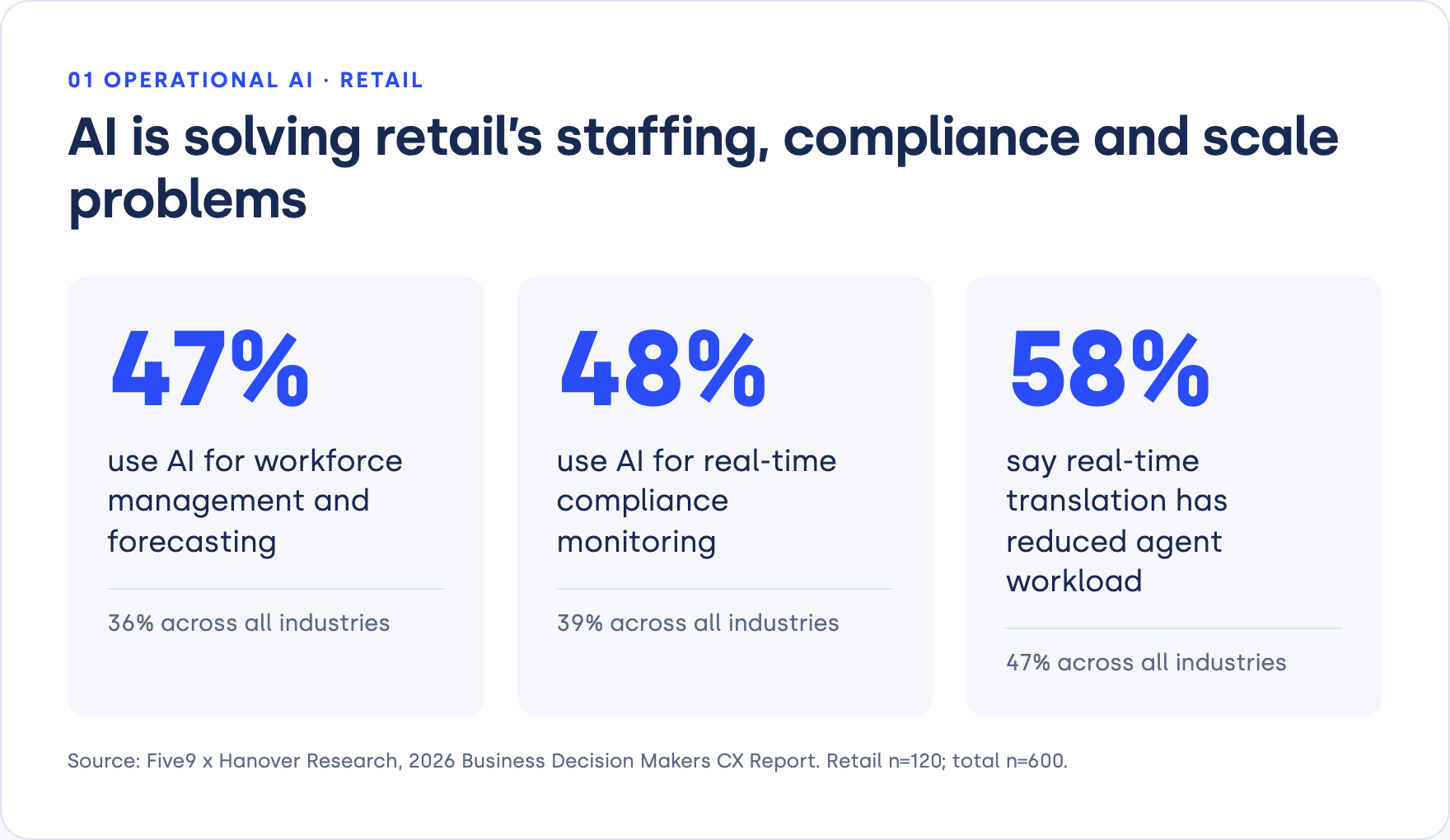
Here’s a number that surprised us. 12% of retail leaders said they faced no challenges or concerns moving to cloud-based infrastructure. Across all industries, it’s 4%. That’s three times the all-industry rate.
But confidence isn’t the same as certainty, and retail leaders were willing to say so. Among those using agent assist, 19% described their return as break-even, about 1 in 5. Across all industries, it’s 10%. Still, 81% of retail agent assist users report a positive return, so this isn’t a story about AI falling short. It’s a story about leaders who are measuring honestly.
We think that candor is a strength. Break-even is a real result, and it usually points to the same fix: connect the tool to the workflow, give agents the right knowledge at the right moment and keep tuning. Leaders who can say “this one isn’t paying off yet” are the ones who go back and make it pay off.
There’s a lesson here for every sector. Confidence gets a program started. Candor keeps it improving. If your team can talk about both in the same meeting, you’re in a strong position.
The takeaway: confidence and candor aren’t opposites. Set the bar for ROI early, and measure against it.
3. Is retail investing in phone or self-service?
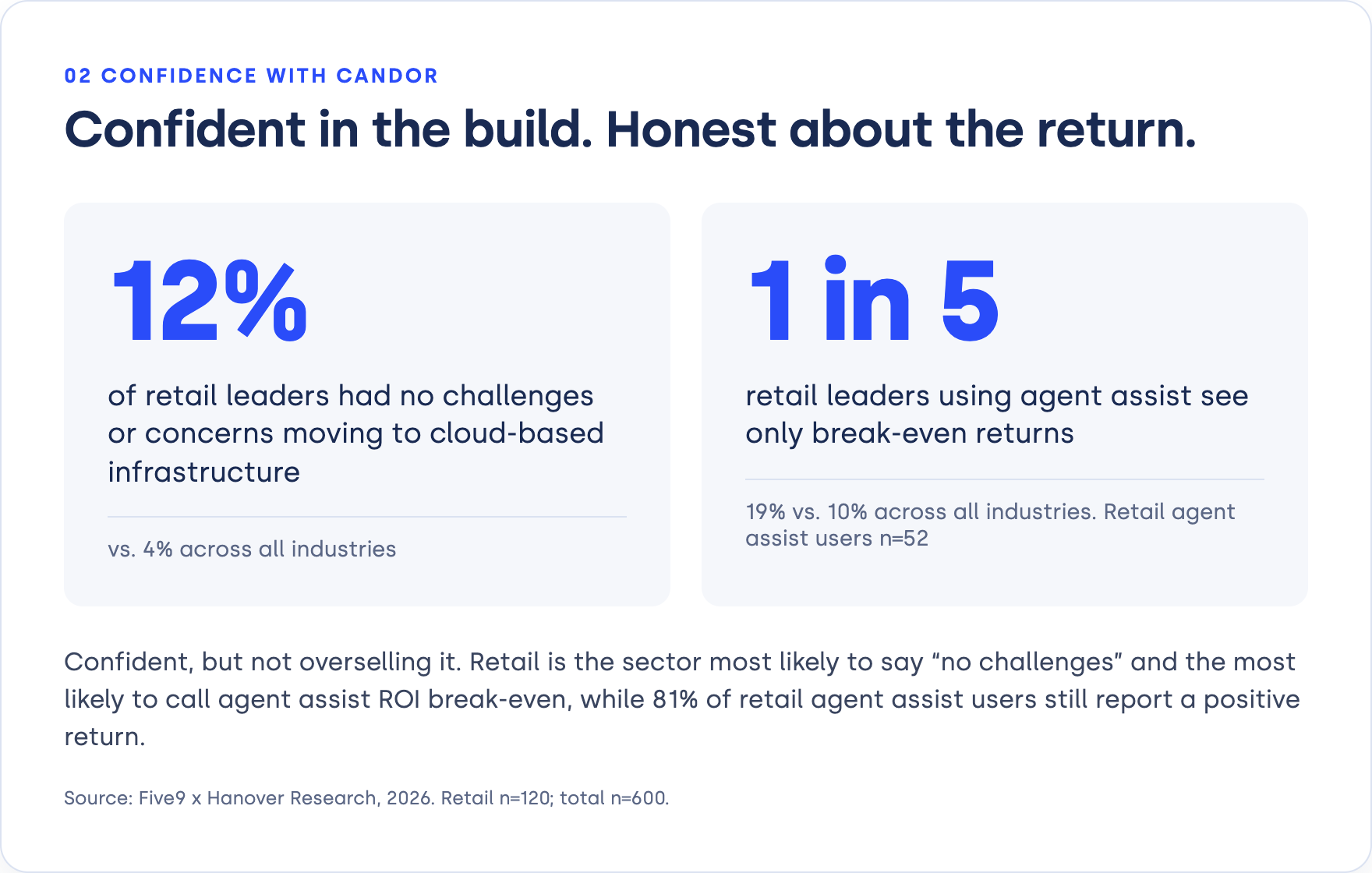
If you expected retail to talk its customers into chat and self-service, the investment data tells a different story. 66% of retail leaders plan to increase phone investment over the next 12 months, compared with 50% across all industries. No other major industry in our study is putting more behind it.
| Channel | Retail leaders planning to increase investment |
|---|---|
| Phone | 66% (all industries: 50%) |
| Messaging apps | 58% |
| Chatbots | 52% |
| Live chat | 52% |
| Self-service help center | 39% (all industries: 48%) |
Retail isn’t skipping digital channels, either. Messaging apps (58%), chatbots (52%) and live chat (52%) all draw serious investment. What stands out is the one channel getting less attention. Only 39% plan to increase investment in a self-service help center, compared with 48% overall.
Read together, those numbers describe a sector that’s meeting customers where they actually are. A shopper with a damaged order or a missed delivery often wants a person and wants one now. A help center article can’t carry that conversation.
It also fits how retail customers behave. Their questions tend to be urgent, emotional and specific to an order. The best experience is one where the customer can start wherever they like, whether that’s a text, a chat or a call, and the next agent already knows what happened. AI can help with that handoff by summarizing the context before a person picks up. That’s the work of making digital and voice act like one channel.
One practical note. 36% of retail leaders name integration with existing IT infrastructure as a top cloud transition challenge, about the same as the 35% overall. Adding channels is the easy part. Connecting them so context follows the customer from chat to phone is where the work is.
The takeaway: don’t pick a channel. Build the connections between them.
How retail leaders can apply these findings
- Start where your operation strains. If staffing swings, begin with forecasting. If compliance reviews eat time, look at real-time monitoring. Add translation if you serve multilingual markets.
- Define a good return before you launch. Check it on a schedule. Break-even tells you where to tune next.
- Keep the phone strong while you grow digital. Make sure every channel shares context, so customers never repeat themselves.
This is the thinking behind Humantic, our view of a world where AI and people work as one team, sharing context and learning from each other. Retail is already moving that way, one practical use case at a time.
Want to see how retail compares across AI adoption, ROI and channel investment? Read the full 2026 Business Decision Makers CX Report from Five9 and Hanover Research.
Frequently asked questions
What is AI doing in retail contact centers today? Retail leaders are using AI mainly for workforce forecasting (47%), real-time compliance monitoring (48%) and real-time translation. These target seasonal demand, compliance and multilingual support rather than customer-facing chatbots alone.
What share of retail leaders use AI for workforce forecasting? 47% of retail leaders use AI for workforce management and forecasting, compared with 36% across all industries, according to the Five9 2026 Business Decision Makers CX Report.
Is agent assist worth it for retail customer service? 81% of retail agent assist users report a positive return. 19% report break-even, which typically signals a need to connect the tool to the workflow and tune the knowledge agents see.
Should retailers invest in phone or self-service? Retail leaders are weighting phone. 66% plan to increase phone investment, versus 39% for self-service help centers. Urgent, order-specific issues often need a person, so the strongest approach connects digital channels and voice with shared context.
How do you measure ROI for contact center AI? Define what a good return looks like before launch and review it on a schedule. Treat break-even results as a signal for where to tune next.
Want to see how retail compares across AI adoption, ROI and channel investment? Read the full 2026 Business Decision Makers CX Report from Five9 and Hanover Research.
Methodology: Five9 and Hanover Research surveyed 600 business decision makers across the US, UK and Germany, including 120 in retail. [INSERT FIELDING DATES.]